

Upstash Box lets you give your AI agents a computer.
Every Upstash Box is a secure, isolated cloud container with an AI Agent built-in. Spin up as many as you want in parallel. Each one includes a full environment with a filesystem, shell, git, and a runtime. Your agent can read files, write code, and execute tasks inside it.
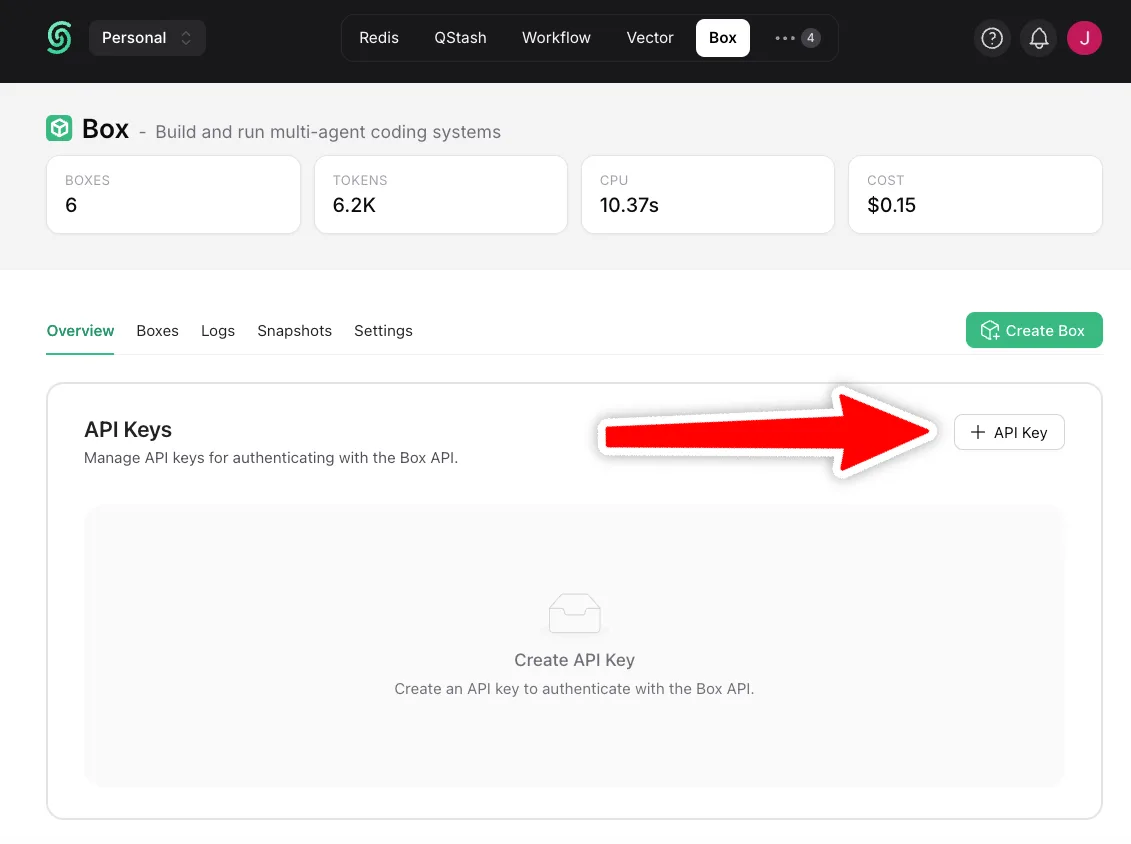
1. Get your API key#
Go to the Upstash Console and create an API key.
2. Install the SDK#
3. Set API Key#
4. Create a Box#
The Python SDK ships both a synchronous Box (used here) and an asynchronous
AsyncBox (box = await AsyncBox.create(...)).
By default, runtimes use Debian (glibc). For smaller Alpine-based images, use "node-alpine", "python-alpine", etc.
Your box is ready to use! You can already use it as a standalone, secure, isolated sandbox with full shell access, git, and filesystem operations.
You can also create a keep-alive box by setting keepAlive: true. Keep-alive boxes stay on between sessions and can run an initCommand at startup. See Keep Alive.
5. Configure an Agent (optional)#
To configure an agent for your box, pass the model you want to use and the provider API key:
6. Run Your First Task#
Your box is ready to use! It's a secure cloud environment to run agents, execute commands, or manage files. For example:
7. Connect over SSH#
You can also connect directly to a box shell with SSH:
When SSH asks for a password, enter your Box API key.
You can copy the exact SSH command for a box from the SSH button on its details page in the Upstash Console.
Use Cases#
The idea behind Upstash Box is simple: give AI its own computer. Your agent gets a full, isolated cloud environment it can control. Run commands, write files, or execute code independent of any user device. Freeze a box anytime, and continue days or even weeks later with perfect resumability.
Great example use cases:
One box per user with durable state. Personalized agents that remember context and improve over time.
Fan out to multiple boxes running specialized agents in parallel, then combine their results.
Run the same inputs across isolated boxes and compare model output side by side.

